
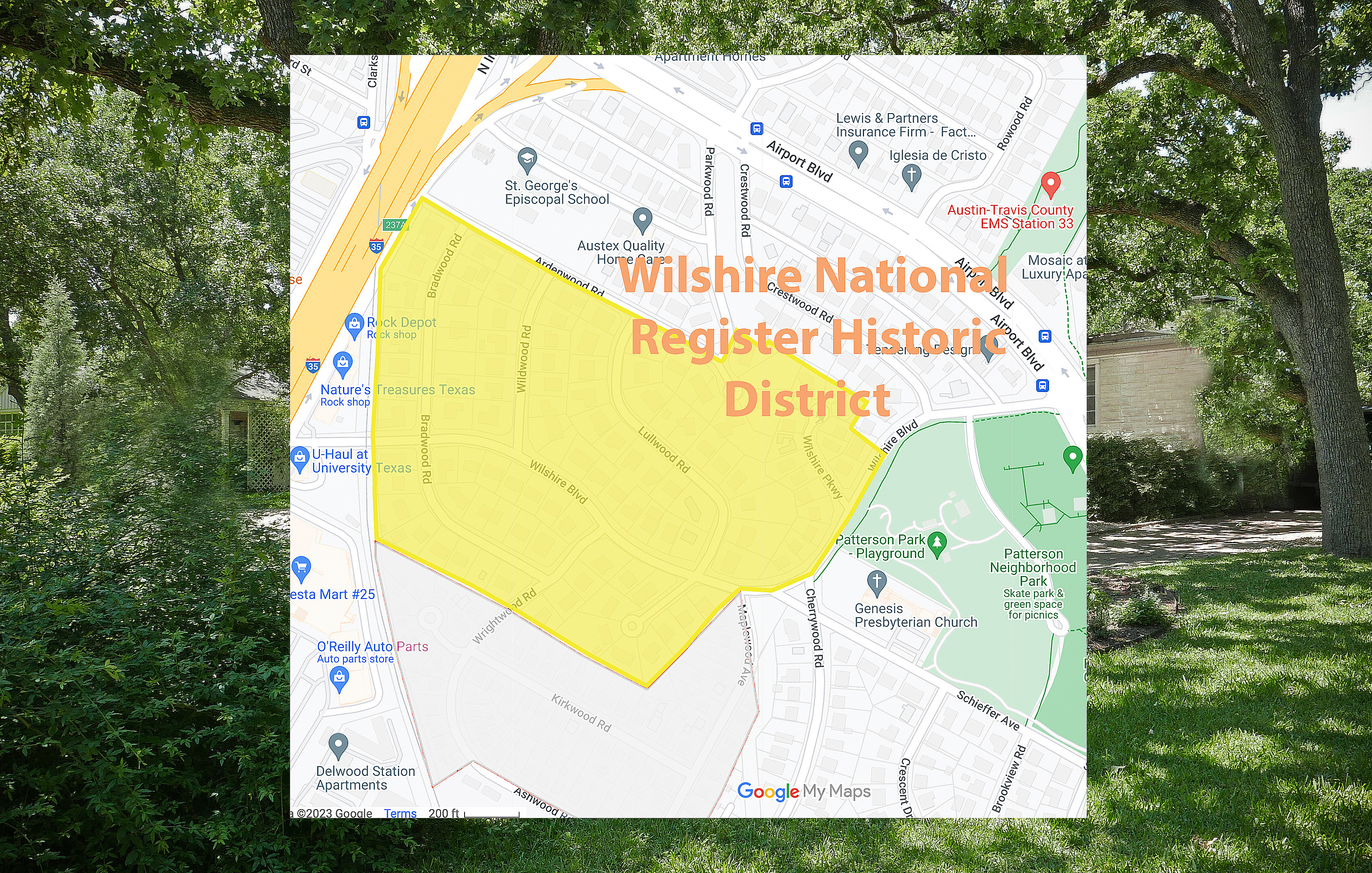
A key part of the WWD1 neighborhood was listed in the National Register of Historic Places in 2011 – as the Wilshire National Register Historic District, a designation granted by the U.S. National Parks Department.
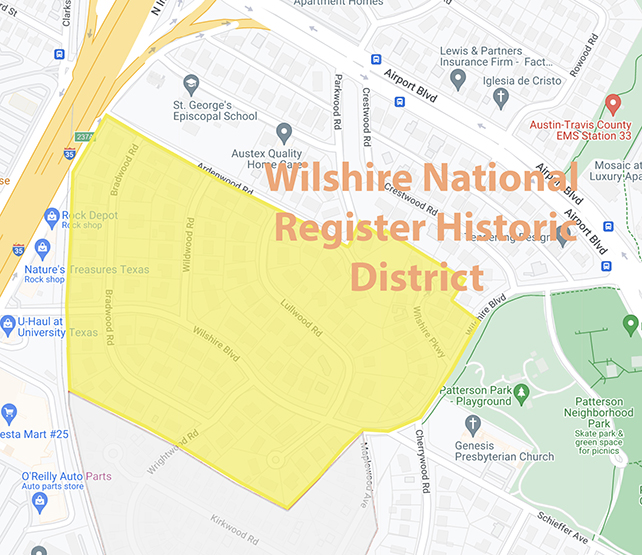
The Wilshire National Register Historic District is bounded by the Southern Pacific Railroad (west side), Ardenwood Rd. (north side), Wilshire Blvd (east side), and Bradwood Rd/Lullwood Rd. cul-de-sac (south side).
The National Register of Historic Places is the official list of the Nation's historic places worthy of preservation. Authorized by the National Historic Preservation Act of 1966 – one of the great legacies of the "Great Society" legislation pioneered by President Lyndon Johnson and the US Congress – the National Park Service's National Register of Historic Places is part of the ongoing national program to coordinate and support public and private efforts to identify, evaluate, and protect America's historic and archeological resources.
The Wilshire National Register Historic District. Local significance of the district: Community Planning And Development; Architecture
The character of the Wilshire National Register Historic District was recognized by the U.S. Parks Department, and architecturally that neighborhood character is still largely intact. More importantly, the stories of our cultural character are replete with the ongoing narratives of many formerly underrepresented communities: women homeowners, women business owners, a long history (dating back to the early 60’s) of LGBTQ+ neighbors active in the community, ethnic diversity on many levels, a variety of prominent progressive political leaders in key Austin and Texas statehouse positions, and organized outreach and support to people experiencing homelessness (very much a part of the mission of St. George’s Church as well as other neighbors).
The Wilshire Historic District neighborhood is made up or two different sections: Wilshire Wood and Wilshire Park. The110 single family home neighborhood was built post World War II within the topography of the land and kept most of the tall trees that populated the area. These stone ranch homes have low pitched roofs, were painted neutral colors and built on large, tree shaded lots.
Wilshire Historic District is a collection of architect-designed Ranch houses built in the 1940s and 1950s. The neighborhood was among the first in Austin to deviate from a rectilinear grid plan and feature irregularly sized and shaped lots on streets that curved with the changes in topography. Most houses were ranch style.
Although topography is a primary reason for the curving street patterns of the Wilshire Historic District—one of Austin's earliest residential developments to deviate from the grid plan—its origins also can be traced to the picturesque, winding streets of the streetcar suburbs of the mid-to-late nineteenth and early twentieth centuries, which began with Frederick Law Olmsted's plan for Riverside, to the southwest of Chicago. Transportation, from streetcars through the automobile, played a significant role in the development of housing removed from the city center, allowing commuters to live in healthy green settings surrounded by grass lawns and gardens, with creeks and trees preserved.
Development exploded throughout the country after the end of WWII, partly due to the Federal Aid Highway Act of 1944. The return of veterans from military service, many of whom had growing families, also spurred this period of growth, as they strove to obtain a secure place among the middle class.
Even as building materials and styles varied across the country, consistencies in development patterns and construction methods may be observed in post-war neighborhoods like Wilshire Wood and Wilshire Park, due to the Federal Housing Authority's planning guidelines. The FHA encouraged appropriate lot sizes and setbacks, street sizes and formation, and access to services and amenities, such as the nearby Delwood shopping center. For their picturesque qualities, curvilinear street layouts and consideration of existing topography were recommended as preferred alternatives to the common gridiron pattern of streets.
The Ranch house—which is often traced to the experimental designs of California architects practicing between the wars—was designed as a sprawling, low-lying, linear dwelling well-suited to spacious suburban lots like those in the nominated Wilshire Historic District. Characterized by asymmetrical, one-story forms with broad facades and low-pitched roofs with deep overhangs, the Ranch house typically incorporated integral garages or carports, emphasizing the importance of the automobile to this neighborhood and housing type. Natural materials, including brick, stone, and wood painted or stained in neutral colors, were the standard for this architectural style. The Ranch house often wrapped around a patio or courtyard space, which were private havens away from the street and ideal for entertaining and family barbecues. Open floor plans provided a luxuriant feeling of spaciousness, even in the smallest of tract homes, while large expanses of glass allowed a visual connection to the outdoors. At the same time, these aspects of a typical Ranch style home also allowed young parents to observe their children at play in dens and "family rooms," and outdoors on neighborhood streets, front lawns, and in backyards. These features are found among the architect-designed Ranch houses of Wilshire Wood and Wilshire Park, as this type became the dominant house form in many American cities from the late 1940s through the 1960s.
The Wilshire Historic District is officially listed in the National Register of Historic Places under Criterion A in the area of Community Planning and Development as an early curvilinear subdivision in Austin and representative of the city's postwar development. It is also nominated under Criterion C in the area of Architecture as a highly intact collection of early to mid-twentieth century Ranch housing styles.
Bibliography
Austin City Directories, 1942-1955, Austin History Center.
"Beautiful Beyond Belief" Advertisement in the Austin American-Statesman (May25,1941) Austin History Center, Wilshire Wood file.
Hardy, Heck, Moore. Interstate Highway 35 Expansion Impact Study (for the Texas Department of Transportation).
Hunter, Christine. Ranches, Rowhouses, and Railroad Flats: American Homes: How They Shape Our Landscapes and Neighborhoods. New York: W.W. Norton & Company, 1999.
May, Cliff Sunset Western Ranch Homes. San Francisco: Lane Publishing Co., 1946.
McAlester, Virginia and Lee. A Field Guide to American Houses. New York: Alfred A. Knopf, 2008
.